March 8, 2025
Fit in or Stand Out
By Suha Beidas Zehl, CMB®, AMSP™
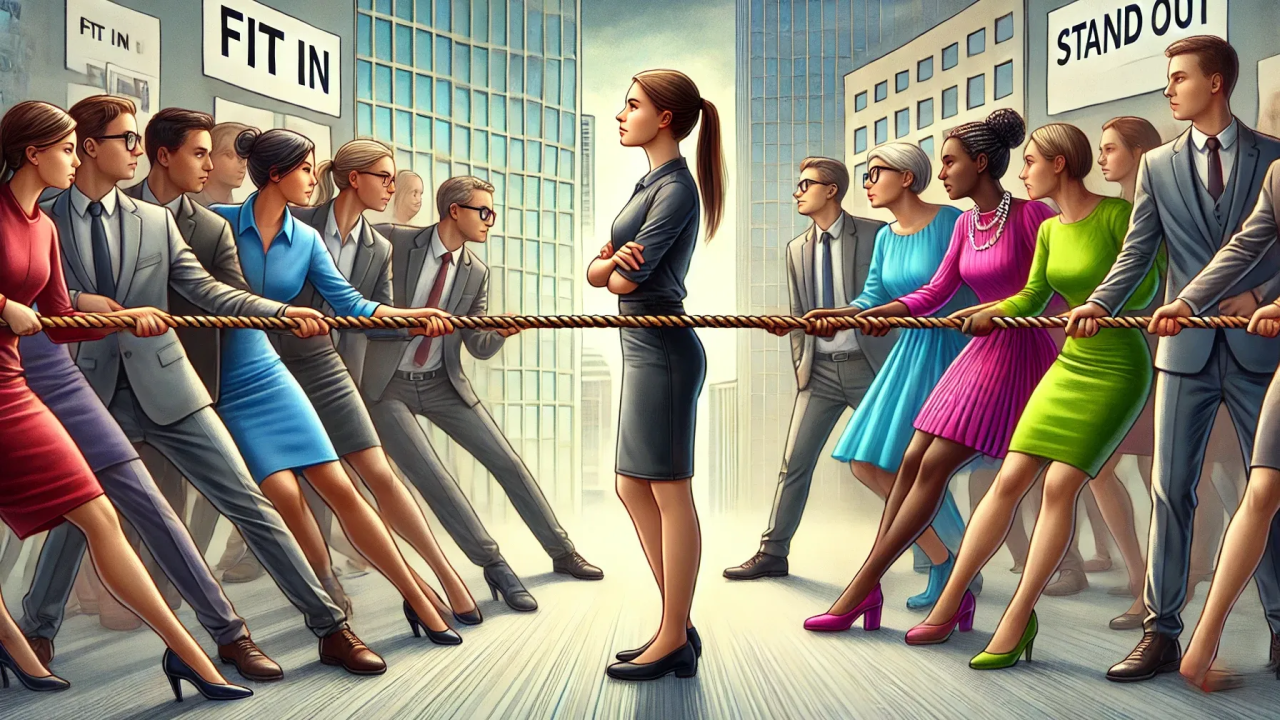
Women’s History Month provides us with an opportunity to celebrate the remarkable achievements of women and to explore the unique challenges that women leaders continue to face today.
One significant challenge many women encounter is the “tug of war” between fitting in and standing out. It’s a delicate dance that can significantly impacts career progression, personal fulfillment, and organizational culture.
Full disclosure: I reached out to 15 women and three men for their insights on this topic and to contribute to this article. Only three women and two men took me up on my offer. That spoke volumes and further confirms that, even in 2025, this struggle continues to be a real challenge for many women.
In today’s evolving workplace, women frequently grapple with this balance.
Harvard Business Review aptly notes that women who authentically assert their identity and uniqueness often navigate complex perceptions. Authenticity, while encouraged, still carries risks of being perceived as "disruptive," particularly for women in leadership roles.
Indeed, this balance of fitting in and standing out directly shapes how effectively organizations innovate, retain talent, and appeal to diverse customers. Molly Dowdy ’s experience in financial services illustrates this clearly:
“I vividly recall moments early in my career, debating internally whether to blend in by mirroring my male colleagues or courageously bringing my distinct viewpoint. Initially, I felt intense pressure to conform. Yet, over time, I recognized that standing out by voicing unique perspectives and advocating for women’s leadership created more meaningful change. Today, I dedicate my efforts to creating environments where women don’t have to choose between fitting in and standing out - they can simply belong.”
Dana Georgiou, CPLA, CFM ’s narrative sheds further light on the systemic challenges women still face, particularly around fitting in/standing out as it relates to compensation and equitable recognition:
“Mid-career, despite managing larger teams than my male counterparts with identical titles and roles, I discovered I earned less. The disparity was jarring. It reflected a culture that subtly penalized standing out and being a woman. These challenges drove my commitment to transparency and advocacy, ensuring that future generations wouldn’t face the same struggles.”
Her experience aligns with extensive research from McKinsey & Company , highlighting persistent disparities in compensation and opportunities, especially for women who visibly stand out through leadership positions or distinctive styles.
Clearly, fitting in or standing out is not merely an individual decision - it’s deeply embedded in organizational culture. McKinsey goes on to stress that organizations where diverse voices are authentically valued experience better financial performance, innovation, and employee engagement.
But what happens when authenticity collides with expectations of conformity in leadership styles? Leora Ruzin, CMB, AMP provides valuable insight into the pain of losing oneself in efforts to fit in:
“Shortly after getting hired, my boss changed, and my new manager disapproved of my leadership approach. I spent eight months attempting to fit her mold, becoming deeply unhappy and ultimately losing my job. This experience taught me that if fitting in demands compromising my core identity, then the place isn’t meant for me. Today, standing out means sharing my passions boldly, inviting others to join or move aside.”
Ruzin’s insight aligns closely with what contemporary research advocates: workplaces must enable diversity in leadership styles to cultivate genuine diversity and innovation.
But what about the men and the allies these women have? I asked a few and here is what they had to share about witnessing a woman’s struggle to achieve that balance and even share their own experience (see, this struggle is not only confined to women):
"I’ve seen firsthand how tough it can be for women leaders to navigate the fine line between fitting in and standing out. One leader in a former organization initially attempted to conform but realized that authenticity was key. When she began leading in her true style - direct, collaborative, innovative - the response was phenomenal. Not only did her team respond positively, but younger women in the organization began emulating her, inspired by her courage to show up as her full self. Eventually, authenticity became her greatest strength."
This resonates deeply with findings published by Forbes , highlighting how authenticity directly correlates with greater job satisfaction, higher performance, and accelerated advancement for women in leadership roles. The message is clear: organizations thrive when women can confidently express their individuality without fearing repercussions.
What about the counterpart of authenticity, vulnerability?
Andrew DeGood shared a powerful personal journey around mental health stigma and the struggle to fit in or be true to who he is:
“For me, the hardest moment of fitting in or standing out was when I was diagnosed with bipolar II in 2010. Initially advised by HR to hide my diagnosis, I wrestled silently, knowing this part of me wasn’t something I could simply discard. However, COVID-19 catalyzed a cultural shift. I finally decided to openly embrace my identity and share it on LinkedIn. This step - coming out of the “BP Closet” - was terrifying yet liberating. Today, embracing this aspect of my identity openly has become integral to who I am professionally and personally.”
His story underscores the broader narrative recognized by Forbes : embracing one’s authentic self, even at personal risk, typically leads to greater personal satisfaction and professional authenticity. Yet, it is clear organizations must evolve culturally to become spaces where differences - mental health included - are not only tolerated but genuinely valued.
Ultimately, creating workplaces that embrace diversity authentically means dismantling the false binary between fitting in and standing out. It means cultivating environments that allow individuals - especially women and minorities - to bring their full selves without fear or hesitation.
Women’s History Month is a timely reminder of our ongoing responsibility to challenge, educate, and advocate.
It reminds us to commit to creating spaces where authenticity doesn’t simply coexist with professional success but actively drives it and encourages being different and standing out.
And yes, while the fight may not be over; women (and men!) will continue to experience this tug of war. But, as leadership expert Brené Brown once said, "Belonging doesn’t require us to change who we are; it requires us to be who we are."
So cheers to all the women (and their men allies) out there who are courageously and authentically standing out! You are showing the way forward to the generations that will come after us.
Thank you Suha Zehl, CMB®, AMP, CCP, CPM for being such a great truth teller. I wish I had known these things when I was early in my career.
Looking forward to reading the article Suha Zehl, CMB®, AMP, CCP, CPM!
Incredibly insightful article. Thanks for shining light on these issues!
Suha, thank you for the incredible leadership you provide and for uniting women in our industry! Jan Davis Kelly Bradshaw Jonna Critchley
So many incredible women on this list! I have to add/shoutout Laura Koller Hopkins, AMP, Marcia Davies, Venita Murray, MBA, AMP, Jordan Bucher, AMP, Alicia Goncalves, CMB® and Marlana Scott, AMP as women who have inspired me in so many ways ❤️🔥
This article series opened with a pattern I kept seeing in different forms. The budget was approved.
My Dad loves to watch news in the morning. Today was no different.