
July 29, 2026
Part 2 - So What’s Missing From Your AI Strategy?
By Suha Beidas Zehl, CMB®, AMSP™
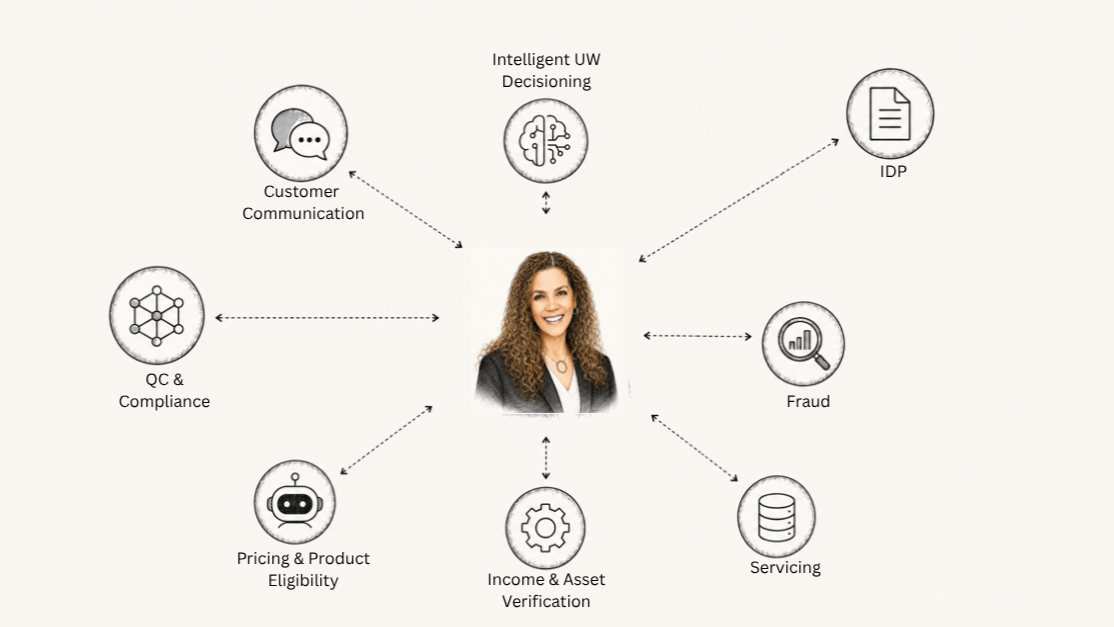
In my first article in this series, I made a claim that a lot of AI strategies would rather not hear. The biggest "thing" missing from your AI strategy is not better technology. It is an AI-ready culture, and the people who make it work.
Many in our industry are still throwing darts at AI. The ones who land their darts in the center are the ones who build the culture around it. And that culture rests on three pillars.
Today, we start with the first: stay human-centered.
Harvard Business Review’s work on the behavioral science of AI adoption makes an argument that should resonate with anyone who has watched a rollout stall. AI adoption fails when leaders treat it as a technology purchase instead of a behavioral change. People resist tools that disrupt their routines, they overreact to visible AI errors, and they default to the familiar comfort of human judgment.
In mortgage lending, human-centered is no longer a preference. It is a control. Fair lending law, adverse action requirements, and model risk expectations all assume a human who can explain a decision. A model that cannot articulate why an applicant was declined does not just create a poor borrower experience. It creates regulatory exposure.
The recent wave of agency and regulatory attention to AI and data use in lending only sharpens this point. We should not treat governance as the brakes on AI in our business; rather we should view it as the steering, keeping us on track and compliant.
There is a customer dimension too. A mortgage is the largest financial decision most people ever make, and it is still, at its heart, a relationship and a moment of trust. AI can remove friction from that experience, but it cannot manufacture the trust. Put the borrower experience first and you quickly find the limits of full automation and intelligent decisioning, and the enduring value of the human at the right moments.
What else? Well, there is also a talent dimension to staying human-centered that our industry is walking straight into. In another Harvard Business Review article, the authors discuss the perils of using AI to replace entry-level jobs.
Eliminate them for short-term savings and you erode the pipeline that produces your senior talent. In mortgage, the roles most exposed to automation are precisely the ones that have always trained our best underwriters and operations leaders: processing, junior underwriting, stipulation clearing, quality control review. If we hollow out those seats, we save money this year and starve our leadership bench for the next decade.
The same authors make a point every risk officer should underline. Their research notes that novices who accept AI output uncritically perform worse than those who question it. In an industry where a wrong income figure or a missed red flag becomes a repurchase request or a fair lending finding, uncritical acceptance of AI is not efficiency. It is risk and exposure; and in our industry, exposure has a price.
Human judgment is the safeguard, which means we have to keep developing it, not automate it away.
Now, if you don’t take anything else from this article, take this:
Judgment is not a fixed asset you protect. It is a capability you have to keep building, a muscle you have to keep exercising. Why? Because in our industry, the guidelines, the tools, and the rules never stop moving. And that is where a lot of lenders fall short. They treat readiness as a one-time event. A tool rollout. A training session. A box checked.
It is not. And in my next article, I’ll make the case that talent development is not a project with an end date. It is an ongoing strategy. Because a human-centered culture is only as strong as the humans in it, and they are never finished growing.
It’s great to see a focus on human-centered design as a core pillar of AI strategy. In my experience architecting national data strategy and AI/ML products, aligning AI initiatives with tangible business outcomes and user needs is crucial for successful adoption and impact.
This article series opened with a pattern I kept seeing in different forms. The budget was approved.
My Dad loves to watch news in the morning. Today was no different.
Putting This Into Practice
This is the work I do with lenders, banks, and credit unions. If your organization is working through these questions, these pages explain how I help.