
September 3, 2026
Part 5 - What’s Missing From Your AI Strategy
By Suha Beidas Zehl, CMB®, AMSP™
This article series opened with a pattern I kept seeing in different forms. The budget was approved. The vendor was selected. The pilot launched, the executive sponsor stayed engaged, and, yet, the results still did not arrive. In the first article, I made the case that the failure point in these efforts is rarely the technology itself.
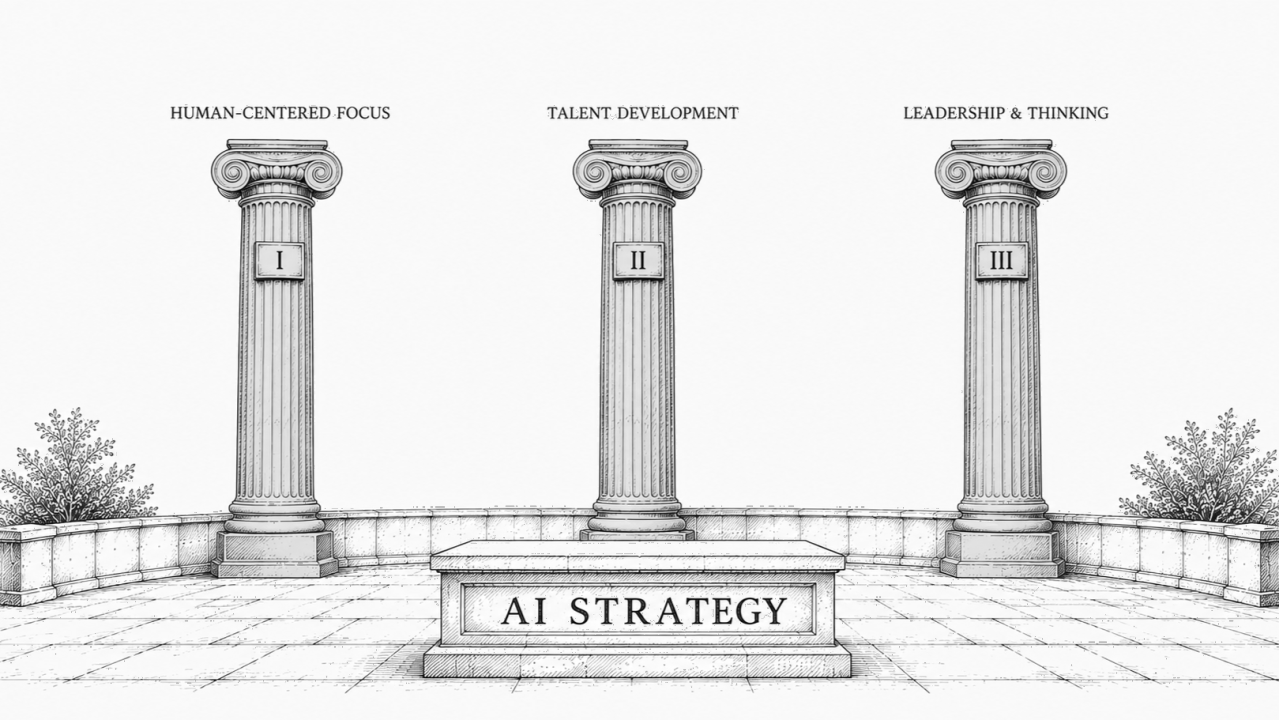
A human-centered focus. In Pillar One, I argued that keeping people at the center is an operational requirement in lending, not a values statement. Human oversight is a competitive advantage and a compliance necessity at the same time. The exceptions, the judgment calls, and the borrower who does not fit the model are where lenders earn trust and where examiners look first.
Talent development as an ongoing strategy. In Pillar Two, I made the case for talent development as a discipline with no finish line. This is also where the distinction that runs through the rest of the series first appears. Allie K. Miller draws a line between people who use AI and people who operate it: the user gets an answer, the operator knows what to ask, what to check, and when the answer is wrong. The market cannot supply operators in the volume this industry needs. They have to be grown from within.
Deliberate development of leadership and thinking skills. In Pillar Three, I addressed what happens after the routine work moves. When AI absorbs the repeatable tasks, judgment becomes the premium skill, and judgment is taught rather than assumed. Leaders who inherited their thinking skills from twenty years of doing the work cannot count on the next generation acquiring them the same way, because the work that produced them is the work being automated.
Put the three pillars together and the shape of an AI-ready culture comes into focus. It is human-centered, because oversight is where lending creates its advantage and meets its obligations. It is built on continuous talent development, because operators have to be grown from within. It is anchored in leadership and thinking skills, because judgment has to be nurtured and taught.
None of this is abstract in a lending operation. The question of who reviews a file the model flagged, and whether that person has the standing to overrule it, is a culture question. So is whether a processor learns the difference between a document that satisfies a checklist and a document that tells you something. So is whether QC audits outcomes or audits the reasoning that produced them. Each of those is a talent question before it is a technology question.
Two lenders can buy the same platform in the same quarter and be in very different places a year later. In one, adoption plateaus at the people who were already curious, and everyone else quietly runs the old process alongside the new tool. In the other, the tool changes how the work gets done, because someone made time for people to learn it, gave them room to be slow while they did, and made competence with it count toward advancement. The solution was identical. The difference was the organization’s appetite to adopt it and its capacity for change.
What leaders control here is narrow and powerful. We control what gets measured, and measurement teaches people what the organization values faster than any memo. We control whether learning time is protected or is the first thing sacrificed when volume returns. And we control what we screen for in hiring, where most organizations are still testing for the skills the tools are absorbing rather than the ones that are about to be scarce.
The timing question answers itself in this business. The capacity to develop people exists in the slower stretches, and the pressure to have those people ready arrives with the next cycle. Waiting for volume to justify the investment means building the culture and running at capacity at the same time.
The difference between an AI user and an AI operator will not stay abstract in this industry. It shows up in pull-through, in loan quality, in audit findings, and in whether our best people stay. The technology will keep improving on its own. People improve when someone creates the environment for growth.
That is the answer to the question this series set out to ask. What is missing from most AI strategies is the talent strategy underneath them. The lenders who understand this will judge any AI investment by the culture it lands in.
That is the real readiness question. It always was.
Who owns week two after the launch? That’s the question this brings up for me. Someone needs to be sitting with the loan team, hearing what’s clunky, and helping them work through it.
Culture and internal alignment always dictate whether AI tools become transformative assets or expensive shelfware.
My Dad loves to watch news in the morning. Today was no different.
Putting This Into Practice
This is the work I do with lenders, banks, and credit unions. If your organization is working through these questions, these pages explain how I help.